
If a baccarat game publishes thousands of digital outcomes, can those results be audited for randomness? Partly, with statistical limits. A Baccarat RNG Output Audit is a post-event review of observed result logs: it asks whether banker, player, tie, totals, card counts, and sequences look consistent with the expected model for that specific game.
This kind of audit is not a betting system and it is not a complete certification of the RNG. It is a disciplined way to identify whether the data appears ordinary, needs more sampling, or justifies deeper technical review.

What a Baccarat RNG Output Audit actually reviews
An output audit focuses on what the game produced, not directly on how the generator was coded. That separates it from a full RNG certification process, which may include source-code review, implementation checks, statistical testing, change control, and security controls.
Output testing is still useful because it works with real production evidence. It can show whether observed results are compatible with the published math. However, it cannot prove that the code, seed management, mapping logic, or deployment process is flawless. NIST describes statistical testing as a useful first step for random and pseudorandom generators, while also warning that no set of tests can absolutely certify a generator; see NIST SP 800-22 for that broader testing context.
The result log must be audit-ready before testing
A meaningful baccarat result log should include enough detail to reproduce the tested population. At minimum, an auditor wants hand ID, timestamp, table or game ID, game version, rule set, shoe or session ID, raw outcome, banker/player/tie classification, final totals, cards dealt, number of cards, and a flag for voided, cancelled, retried, or incomplete hands.
Timestamps and version numbers matter because a clean overall sample can hide a problem that appears only after a software update or only during one provider session. Voided hands matter because excluding or including them inconsistently can distort frequencies. If raw RNG values are available, they should be separated from player-facing outcomes, because mapping errors can occur between random numbers, virtual cards, and displayed results. For virtual shoe games, shuffle integrity and card mapping become part of the investigation boundary.
Baccarat needs a game-specific expected distribution
The benchmark must match the tested baccarat rules. Standard 8-deck punto banco is not the same as a commission-free variant, side-bet product, live shoe, or proprietary RNG table game. If a supplier provides a PAR sheet or math file, that document should define the expected distribution.
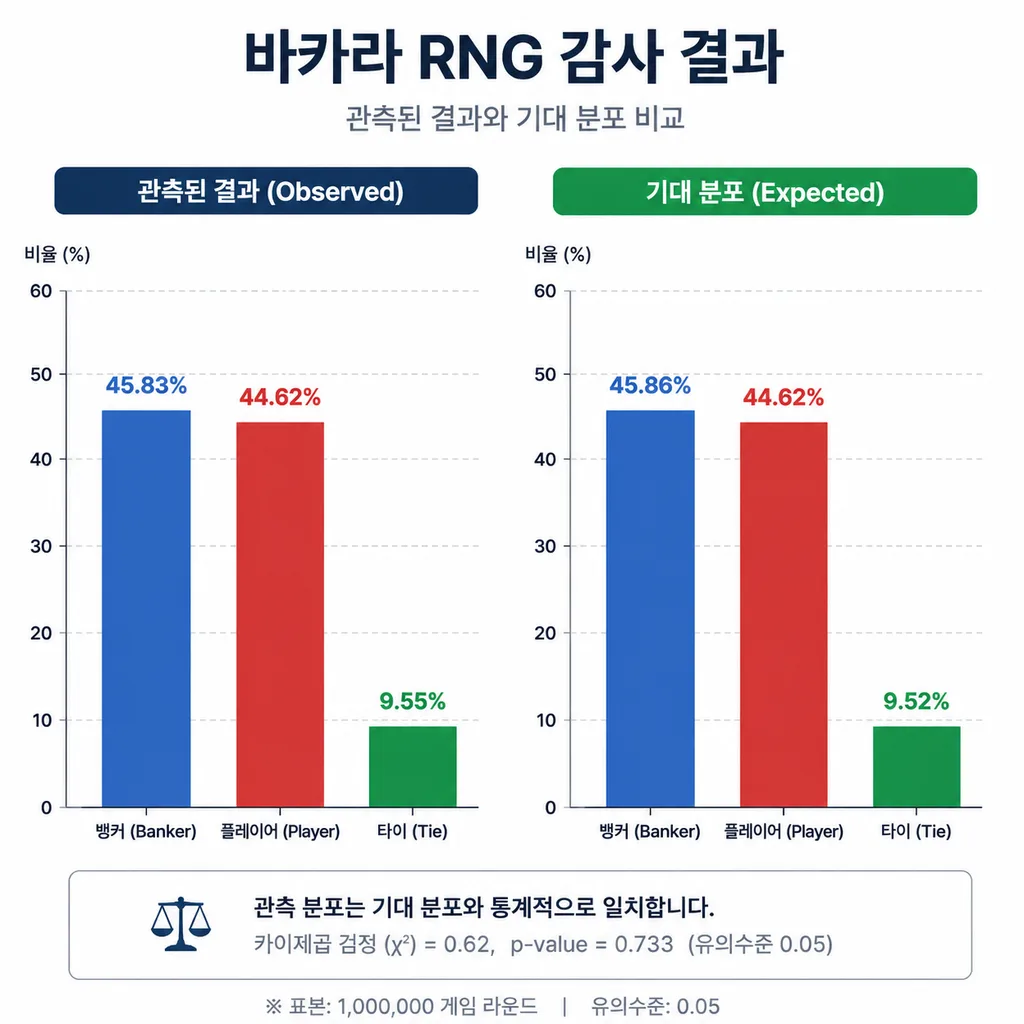
For standard 8-deck baccarat, commonly cited long-run outcome proportions are approximately 45.86% banker, 44.62% player, and 9.52% tie, depending on the exact counting convention. Detailed combinational benchmarks for baccarat hands are available from sources such as Wizard of Odds. Those probabilities also explain the baccarat house edge; they do not imply that short samples should match perfectly.
First-line tests look for distribution bias
The first pass is usually simple: count outcomes and compare observed frequencies against expected probabilities. Confidence intervals help show whether a deviation is plausible for the sample size. For example, a small excess of banker results may be ordinary in 5,000 hands but more concerning if it persists across 5,000,000 hands and multiple independent periods.
A chi-square goodness-of-fit test is often used for banker/player/tie frequencies, final-total categories, number-of-card distributions, or other predefined buckets. The p-value estimates how unusual the data would be if the expected model were correct. It does not measure the probability that manipulation occurred. A very small p-value is a signal for replication and review, not a direct accusation.
Good audits also avoid testing only the most suspicious-looking category after seeing the data. If the plan includes 50 separate tests, some odd results may appear by chance. Multiple testing adjustments, documented thresholds, and a locked test plan reduce cherry-picking risk.
Sequence tests look for memory, cycles, and clustering
Baccarat output testing should not stop at totals. A biased generator or mapping issue might leave sequence-level traces even when headline frequencies look acceptable. Runs tests can compare the number and length of banker or player streaks against the expected distribution. Streaks are not automatically suspicious; baccarat naturally produces long runs from time to time.
Serial correlation and autocorrelation tests check whether one result helps predict the next beyond what the math model allows. A transition matrix can compare banker-to-banker, banker-to-player, tie-after-player, and similar transitions against expectation. Repeated blocks, identical session patterns, or drift by hour can suggest implementation, seeding, caching, or operational issues that require closer inspection.

Sample size changes the meaning of every anomaly
Short baccarat logs are noisy. A tie drought, alternating pattern, or unusually long banker streak may feel strange to a human observer but still be compatible with randomness. Larger samples narrow confidence intervals and make persistent deviations easier to evaluate. Concepts such as Bayesian convergence can help explain why new evidence changes confidence gradually rather than instantly.
Before reviewing the data, an auditor should define the population, excluded records, expected distribution, tests, significance thresholds, and escalation rules. Pre-registration does not make the math perfect, but it makes the conclusion more credible.
Signals that justify deeper investigation
Red flags include banker/player/tie deviations that persist across large independent samples, unusual shifts after a software release, outcome changes tied to a specific table or session ID, abnormal final-total distributions, repeated blocks, or clustering that survives replication. A strong signal should be described carefully: within tolerance, requires replication, requires implementation review, or requires source and operational review.
An output audit cannot fully evaluate seed entropy, source-code quality, RNG state handling, deployment controls, or whether a certified version is the same version running in production. Industry standards and regulators often address broader technical and security expectations, but observed-output analysis remains only one layer of assurance.
A practical checklist for a Baccarat RNG Output Audit
- Define the exact baccarat rule set, version, and expected math model.
- Collect complete logs with hand IDs, timestamps, outcomes, totals, cards, sessions, and void flags.
- Clean the data consistently and freeze the audit plan before looking for anomalies.
- Compare observed and expected frequencies with intervals and chi-square tests.
- Run sequence checks for runs, transitions, autocorrelation, repeated blocks, and session drift.
- Adjust for multiple testing and avoid treating one short-sample streak as proof.
- Escalate only when anomalies survive replication and match a plausible technical failure mode.
The responsible conclusion is rarely a dramatic pass-or-fail claim. A well-run Baccarat RNG Output Audit should state what was tested, what was not tested, how large the sample was, and whether the evidence is ordinary or needs deeper review. Fair randomness preserves the game’s published odds; it does not create a winning system.