
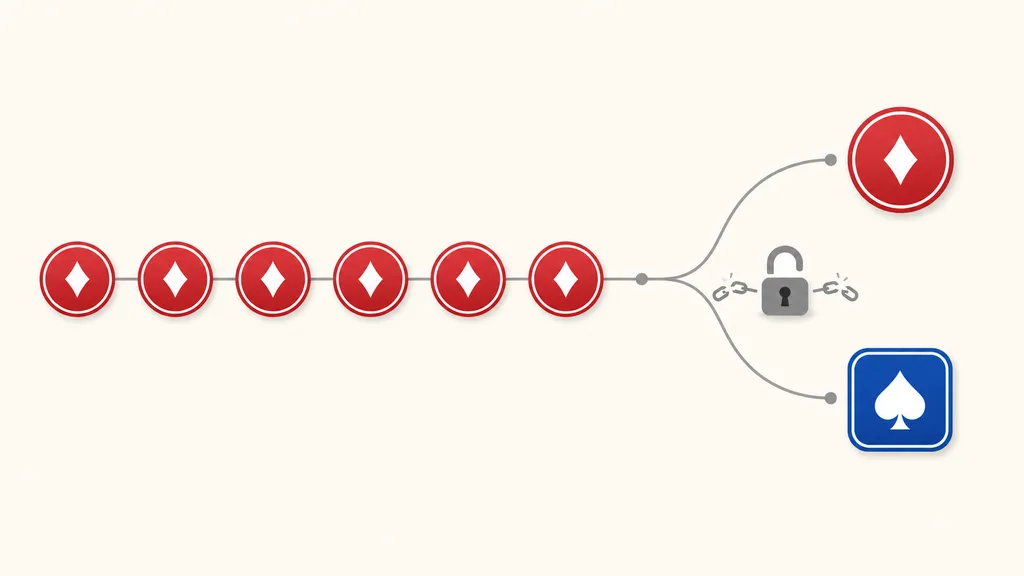
If Banker has appeared seven hands in a row, is Player now more likely to win the next hand? This is the classic Baccarat Gambler’s Fallacy: the belief that a random or near-random sequence must “balance out” soon because one result has appeared too often. It feels logical at the table, especially when the scoreboard is glowing with a long red or blue line, but it is not a reliable way to predict the next baccarat hand.

What Is the Baccarat Gambler’s Fallacy?
The APA Dictionary of Psychology defines gambler’s fallacy as the mistaken belief that a random event is influenced by previous random events. In baccarat, the simple version is: “Banker has come up too many times, so Player is due.”
The error is not noticing a streak. Streaks really do happen. The error is assuming the streak creates pressure on the next hand to reverse. “Due” is an emotional word, not a probability signal. A shoe, a continuous shuffling machine, or an online random number generator does not remember that you are frustrated, excited, or waiting for a comeback.
Why Baccarat Streaks Feel Predictive
Pattern detection is useful, but not always accurate
Human brains are built to detect patterns. That skill helps us learn language, avoid danger, and make quick decisions. At the baccarat table, however, the same instinct can turn a visual sequence into a story: “Banker is hot,” “Player is overdue,” or “Tie must arrive soon.” The story feels meaningful because the scoreboard makes the sequence easy to see.
The table does not self-correct on your schedule
Long-term probabilities can settle toward expected averages over many trials, but that does not mean the next hand must repair the recent past. A short run of Banker outcomes does not force an immediate Player result. Likewise, a long absence of Tie does not create a countdown to Tie. Short-term variance can look dramatic before larger samples smooth out.
Scoreboards and roads create visual pressure
Baccarat roads are useful for recording past outcomes, but they are not prediction engines. Big Road, Bead Plate, Big Eye Boy, Small Road, and Cockroach Pig can make historical results look organized and almost intentional. They show what happened; they do not prove what must happen next.
Are Baccarat Hands Truly Independent?
It is common to say baccarat hands are independent, but the precise answer depends on the game format. In a traditional shoe game, cards are removed as the shoe progresses, so the composition of remaining cards changes. That means the game is not perfectly independent in the strict mathematical sense.
For normal players, though, the displayed Banker, Player, and Tie pattern is not strong enough to be a practical prediction signal. Seeing “Banker, Banker, Banker” does not tell you the exact remaining card composition in a useful way. In CSM games and online RNG baccarat, the argument for pattern reading becomes even weaker because past displayed results have even less reason to affect the next result.
Common Gambler’s Fallacy Traps in Baccarat
Player is overdue after a Banker streak
This is the most familiar trap. A player sees five, seven, or ten Banker results and assumes Player must arrive. The next hand may be Player, but not because the table owed it to anyone.
Tie must come soon after a long absence
Tie is especially tempting because it appears less often than Banker or Player. When it has not appeared for a while, the absence feels meaningful. In reality, “not seen recently” is not a reason to treat a high-house-edge wager as safer.
Doubling after losses
Progression systems such as Martingale often become dangerous when combined with gambler’s fallacy. The player thinks a reversal is due, raises the next bet, loses again, and then must increase even more to chase the same idea. Table limits, bankroll limits, and emotional pressure can all arrive before the hoped-for correction.
Switching sides because the table owes a reversal
Changing from Banker to Player can be harmless if it is part of a fixed entertainment plan. It becomes risky when the reason is revenge against the scoreboard. The table does not owe a pattern break.
Baccarat Odds That Matter More Than Streaks
The numbers that deserve more attention than road patterns are the house edges. According to Wizard of Odds baccarat tables, a typical 8-deck game has approximately the following house edges:
| Bet | Approximate house edge | Practical takeaway |
|---|---|---|
| Banker | 1.06% | Usually the lowest house edge, but not a prediction tool |
| Player | 1.24% | Slightly higher than Banker in many standard games |
| Tie | 14.36% | Much higher risk despite the attractive payout |
A low house edge does not mean the next hand is predictable. It only describes the average cost of the wager over a large number of bets under the posted rules. Short-term results can still swing sharply, and a long streak can still appear without giving you a reliable edge.

Gambler’s Fallacy vs Hot-Hand Fallacy
Gambler’s fallacy usually bets against the streak: “Banker has won too much, so Player is next.” Hot-hand fallacy usually bets with the streak: “Banker keeps winning, so Banker is hot.” These look opposite, but they share the same root problem. Both give past outcomes more predictive power than they deserve.
A disciplined player can record results for interest without turning every line on the board into a command. The key question is not “What story does the road show?” but “Am I making this wager because of rules, limits, and risk awareness, or because the pattern feels like it must mean something?”
How to Reduce Gambler’s Fallacy at the Table
- Set stake size before play. Decide your unit size before the first hand, not after a painful streak.
- Avoid “due” language. If your reason for betting is “Player is due” or “Tie has to come,” pause.
- Use stop-loss and time limits. Limits work best when they are written down before emotions rise.
- Do not increase automatically after losses. Chasing can turn a small negative run into a bankroll problem.
- Treat each decision as fresh. Past results may be interesting, but they should not be treated as a guarantee.
- Step away after emotional streaks. Excitement and frustration both make patterns feel more convincing.
Key Takeaways for Baccarat Players
The Baccarat Gambler’s Fallacy gets one thing wrong: it treats the scoreboard as if it has memory and intention. Banker streaks do not make Player “owed.” A missing Tie does not become safer because you have waited. A road map can summarize history, but it cannot promise the next card sequence.
Responsible baccarat play starts with probability literacy. Know the house edge, respect variance, avoid chasing losses, and be honest about emotional triggers. If gambling stops feeling like entertainment, or if you feel driven to recover losses, increase stakes, or continue despite negative consequences, take a break and seek support from a qualified problem gambling resource in your region.