
Loss Aversion and the Anchoring Effect in High-Variance Decision Making
I. The Foundations of Prospect Theory and Loss Aversion
The foundational treatment of loss aversion in the modern behavioral economics literature originates with the 1979 paper by Daniel Kahneman and Amos Tversky published in Econometrica, in which the authors documented a systematic departure of observed human decision-making from the predictions of classical expected-utility theory. The core empirical finding — that human decision-makers weight losses approximately 2.0 to 2.5 times more heavily than gains of equivalent magnitude — has been replicated across thousands of subsequent experimental studies and stands as one of the most robust findings in the modern behavioral sciences.
According to the comprehensive treatment provided by Investopedia’s analysis of loss psychology, loss aversion is best understood not as an irrational error in human cognition but as a deeply embedded evolutionary adaptation. Organisms that weighted potential losses heavily relative to potential gains were structurally advantaged in ancestral environments where survival often depended upon avoiding catastrophic resource depletion rather than maximizing expected resource gain. The asymmetry is, in effect, a feature rather than a bug of human cognition — a feature, however, that operates with substantial dysfunction in the modern high-variance environments analyzed by the BCRC.
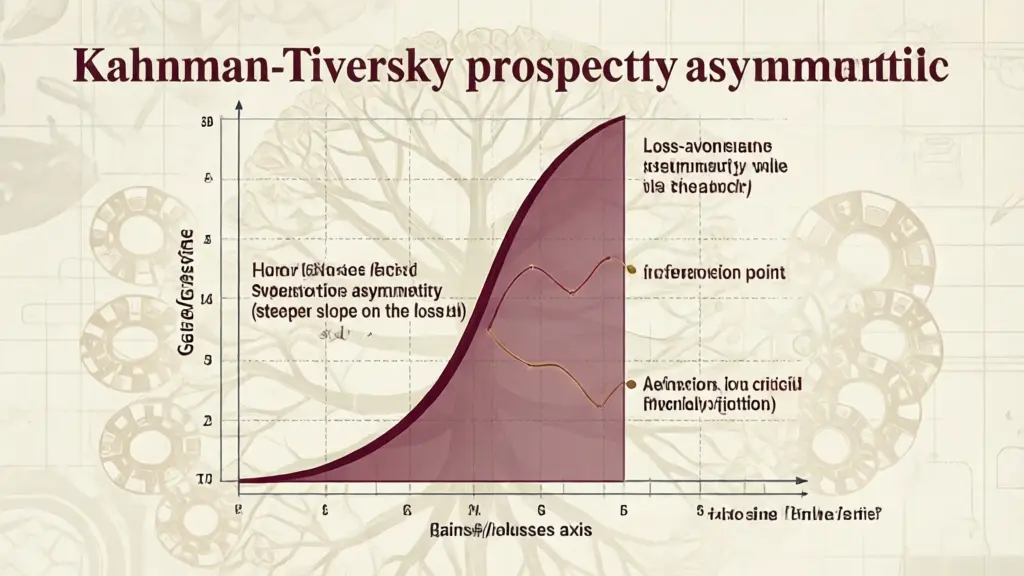
The mathematical expression of loss aversion within Prospect Theory takes the form of an asymmetric value function, illustrated in Figure 3.1, in which the slope of the function in the loss domain is approximately 2.25 times steeper than the slope in the gain domain. This single coefficient — the loss-aversion ratio λ ≈ 2.25 — captures the structural cognitive asymmetry that generates the documented behavioral pattern. The function is also characterized by concavity in the gain domain and convexity in the loss domain, reflecting the diminishing marginal value of additional gains and the increasing marginal pain of additional losses near the reference point.
The institutional importance of loss aversion in the context of Baccarat and related high-variance environments is precisely that it operates against the disciplined application of the quantitative findings documented in the BCRC’s empirical game theory monograph. A practitioner who understands the 1.24-percent banker–player edge differential intellectually may nonetheless deviate from optimal allocation under loss-aversion pressure, particularly during sustained losing sequences in which the perceived pain of accumulated losses generates emotional pressure to alter the strategic framework irrationally.
II. The Anchoring Effect and Reference Point Dependency
While loss aversion describes the asymmetric weighting of losses versus equivalent gains, the anchoring effect describes a complementary cognitive distortion in which decision-makers exhibit excessive sensitivity to recent reference points when evaluating subsequent outcomes. The reference point — typically the most recent salient outcome or the most recent equilibrium point — functions as a cognitive anchor against which all subsequent outcomes are evaluated, frequently producing distortions of judgment that compound the underlying effects of loss aversion.
In the context of high-variance probabilistic environments, the anchoring effect manifests most consequentially through two mechanisms. The first is the establishment of session-level reference points: a practitioner who enters a session with a specific capital position will anchor subsequent evaluation to that initial position, perceiving any drawdown from the entry point as a “loss” subject to the full force of loss aversion, even when the drawdown remains well within the expected variance range predicted by the underlying probability framework.
The second mechanism is the establishment of peak-level reference points within an active session. A practitioner whose capital reaches a positive excursion above the entry point frequently anchors subsequent evaluation to the peak rather than the entry, perceiving any retracement from the peak as a “loss” even when the resulting capital position remains positive relative to the entry point. This phenomenon — sometimes termed the “house money effect” in the popular literature — is a well-documented manifestation of dynamic reference-point updating under conditions of loss aversion.
The Stanford Encyclopedia of Philosophy entry on Game Theory provides a careful philosophical treatment of these reference-point phenomena, situating them within the broader literature on bounded rationality and the limits of expected-utility maximization as a descriptive framework for human decision-making. The implication for the BCRC’s research program is that no purely quantitative strategy can be deployed in isolation from a corresponding behavioral framework designed to neutralize the systematic distortions introduced by anchoring and loss aversion.
III. The Gambler’s Fallacy in High-Variance Environments
The gambler’s fallacy — the cognitive misconception that past outcomes of an independent random process influence the probability of future outcomes — interacts with loss aversion in characteristic and operationally consequential ways. The fallacy is most commonly manifested as the belief that an extended losing sequence increases the probability of a subsequent winning outcome, or symmetrically that an extended winning sequence increases the probability of a subsequent reversal.
From a strictly mathematical standpoint, the gambler’s fallacy is unambiguously incorrect under conditions of independent draws: the probability of any specific outcome on a given trial is conditioned exclusively upon the structural probability distribution governing that trial, and is in no way modified by the sequence of prior outcomes. The Bayesian convergence framework described in our quantitative research monograph makes this explicit, demonstrating that the asymptotic distribution of outcomes converges to its theoretical expectation precisely because each draw remains independent of all preceding draws.
The behavioral significance of the gambler’s fallacy lies in its interaction with loss aversion. A practitioner experiencing an extended losing sequence is operating under simultaneous pressure from two sources: the direct emotional weight of accumulated losses (mediated by loss aversion) and the cognitive expectation that the sequence is “due” to reverse (mediated by the gambler’s fallacy). Under combined pressure from these two effects, practitioners commonly deviate from their stated strategic framework — increasing wager size, abandoning prior allocation discipline, or shifting from the statistically favored banker position to the player position on the basis of perceived pattern dynamics.
The empirical evidence from behavioral economics research is unambiguous: these deviations systematically reduce expected long-run outcomes relative to disciplined adherence to the underlying probability framework. The BCRC’s institutional research program treats the gambler’s fallacy not as a remediable lapse in judgment but as a predictable physiological response to the combined pressures of loss aversion and pattern-seeking cognitive bias.
IV. Behavioral Neutralization Protocols
The BCRC’s behavioral framework treats loss aversion as a physiological event rather than a character flaw, and accordingly prescribes systematic neutralization protocols rather than appeals to discipline or willpower. When a practitioner experiences a negative variance event — what the popular literature terms a “bad beat” — the amygdala initiates a fight-or-flight response, effectively suppressing the prefrontal cortex regions responsible for deliberative decision-making. Under such physiological conditions, no amount of intellectual understanding of the underlying probability framework will reliably prevent deviation from the stated strategic plan.
The institutional response to this physiological reality is the implementation of what the BCRC terms Mental Deceleration Protocols: systematic procedural interventions designed to neutralize the biological drag introduced by loss aversion before it can corrupt the decision-making process. These protocols typically include mandatory pause intervals following loss sequences exceeding a defined threshold, structured breathing techniques designed to reduce sympathetic nervous system activation, and the implementation of pre-committed decision frameworks that remove discretion from the moment of physiological stress.
The principles underlying these protocols are not unique to gaming environments. The Bank for International Settlements literature on operational risk management documents extensively the application of analogous protocols in institutional financial trading environments, where loss aversion among professional traders has been documented as a primary source of operational risk and a frequent contributor to catastrophic loss events. The translational application of these institutional risk-management principles to high-variance gaming environments is a central focus of the BCRC’s behavioral research program.
It is worth noting that the algorithmic integrity of the underlying gaming platform, addressed in detail in the companion monograph on seed entropy and RNG integrity, is a necessary prerequisite for the deployment of any behavioral neutralization framework. Without confidence in the structural fairness of the underlying random number generation, no behavioral discipline can produce sustainable long-run outcomes; the practitioner is, in such circumstances, attempting to apply rational discipline against a system that does not conform to its purported probability distribution.
V. Conclusion
The findings documented in this monograph confirm that loss aversion, the anchoring effect, and the gambler’s fallacy constitute the three primary cognitive obstacles to the disciplined deployment of quantitative strategy in high-variance probabilistic environments. These biases are not character flaws subject to remediation through intellectual effort but predictable physiological responses subject to systematic neutralization through structured behavioral protocols. The institutional understanding of this distinction is foundational to the BCRC’s behavioral research program.
The integrated implication of the BCRC research program is that no single analytical dimension is sufficient for sustainable performance in high-variance environments. The quantitative framework establishes the mathematical structure within which decisions occur. The algorithmic integrity framework establishes whether that mathematical structure actually governs the operational platform. The behavioral framework documented here establishes whether the practitioner can reliably translate intellectual understanding into operational discipline. And the regulatory topology framework establishes whether such practice is permissible in the practitioner’s jurisdiction. Each represents a necessary, but individually insufficient, component of an integrated institutional approach.
Future BCRC behavioral research will examine the empirical effectiveness of specific Mental Deceleration Protocols across varying practitioner populations and environment types, with particular attention to the question of whether loss aversion can be measurably reduced through structured practice or whether the most effective interventions operate at the procedural level rather than the cognitive level. The provisional answer suggested by the existing behavioral economics literature is that procedural intervention dominates cognitive intervention in this domain — but the question warrants further institutional study.
Related Research
- Bayesian Convergence in Baccarat: Empirical Game Theory Models — BCRC Vol. 26-Q1, Quantitative Research
- Seed Entropy and the Integrity of Random Number Generation in Digital Gaming — BCRC Vol. 26-A1, Algorithmic Audits
- Regulatory Topology of Global iGaming: A Jurisdictional Comparative Framework — BCRC Vol. 26-M1, Market Analysis
BCRC Research Monograph Vol. 26-B1 · Behavioral Studies · ISSN: 2024-BCRC