
The live-dealer table is moving quickly, and the road display now shows seven Banker marks in a column. Your chips are still untouched, yet the next Player wager begins to feel unusually persuasive. The thought arrives with its own sense of urgency: the run has gone far enough, so Player must be close. Learning how to stop the gambler’s fallacy in baccarat betting begins in this small interval between seeing a sequence and treating it as a forecast. The goal is to notice that pressure, identify what created it, and make a decision under rules you chose while calm.

Catch the symptoms while the bet is still optional
The American Psychological Association defines the gambler’s fallacy as the mistaken expectation that earlier random outcomes influence a later random event. Our broader guide to the baccarat gambler’s fallacy covers that foundation. At the table, detection is more useful when it focuses on your language and actions.
Listen for a quiet “due,” “has to,” or “cannot keep going.” Watch for an absent Tie starting to feel imminent, even though its absence supplies no deadline. Notice when road-map colors make you reverse from Banker to Player, or when several losses make a larger unit feel justified. Selective memory also matters: a dramatic reversal you called correctly is easy to recall, while the many failed calls fade.
- I expect the sequence to balance within the next few coups.
- I changed sides only after looking at the latest marks.
- I raised my stake to recover losses during the expected reversal.
- I would struggle to explain this wager without saying “streak” or “due.”
One checked box is enough to pause. It is a warning signal and does not diagnose you as a person.
Why a short streak feels like useful evidence
Representativeness is the first common cause. We expect a small sample to resemble the balanced-looking distribution we imagine over a very long span. Six Banker results therefore feel incomplete, and a Player result seems capable of repairing the picture. Random sequences regularly look lopsided for uncomfortable stretches, so visual imbalance alone creates no correction schedule.
Pattern salience adds force. Baccarat road maps compress history into colored circles, columns, and recognizable shapes. During game-record reviews, I find that my attention reaches the longest run before it reaches quieter information. The display performs its recording job well; the mind turns that record into a story with a next chapter.
Emotional recovery pressure can then connect three separate problems. Gambler’s fallacy says Player is due. Trend-following says the Banker run should continue. Loss chasing says the next wager should be larger because money must be recovered. A player can switch among all three within minutes, especially as losses and baccarat decision fatigue shorten the pause before each bet. Ask which claim is driving the proposed wager. Naming the mechanism makes the response easier to choose.
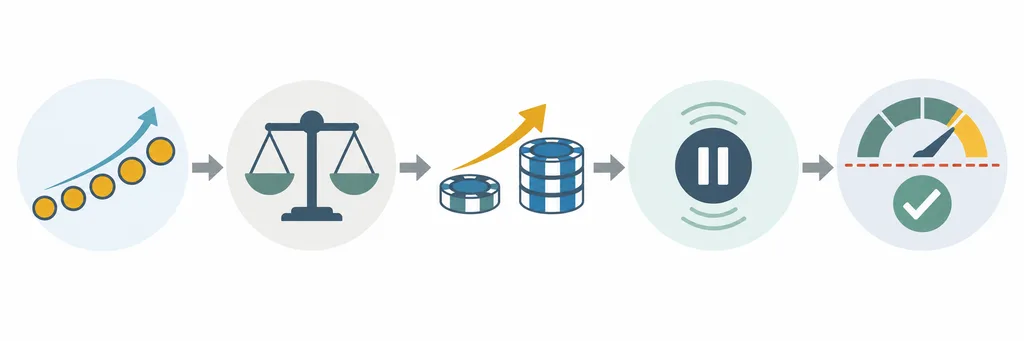
What the baccarat math can and cannot tell you
In baccarat, Banker and Player name betting positions and dealt hands; neither label represents a person seated at the table. For a standard eight-deck game, the published eight-deck calculations give the following long-run reference values:
| Outcome or bet | Approximate probability | House edge under stated rules |
|---|---|---|
| Banker | 45.8597% | 1.06% with 5% commission |
| Player | 44.6247% | 1.24% |
| Tie | 9.5156% | 14.36% at 8:1 |
These figures vary with deck count, commission, variant rules, and pay tables. House edge describes an expected average cost across extensive play. It does not forecast the next coup or promise a session result; our guide to baccarat house edge by bet type explains that distinction in more detail.
A traditional shoe is finite. Removing cards changes its composition, so successive hands are not perfectly independent in the strict mathematical sense. Yet a row of Banker and Player marks omits the ranks and quantities remaining in the shoe, along with the detailed conditional calculation needed to assess composition. The ordinary scoreboard is therefore an inadequate forecasting signal.
RNG baccarat is a separate implementation. Regulated systems are expected to produce acceptably random, unpredictable results without adapting probabilities in response to play. The same practical point survives: a long-run proportion imposes no short-run deadline for Player, Banker, or Tie to appear.
How to stop the gambler’s fallacy in baccarat betting before the next wager
- Catch the trigger words. When you hear “due,” “overdue,” “must reverse,” or “cannot happen again,” say the phrase silently in full. “I think Player is due because Banker won seven times” is easier to inspect than a vague feeling.
- Pause before chips move. Take your hand away from the betting controls or chip area for one complete betting round. A skipped coup costs no wager. Slow breathing or a sip of water can mark the pause, although neither action changes the cards.
- Run the change test. Ask, “Would I make this same wager at this same size if the road display were blank?” If the answer is no, recent outcomes changed the decision. Record that fact without debating whether the pattern looks especially convincing.
- Check the written unit rule. Compare the proposed amount with the fixed maximum you wrote before play. Any increase caused by a losing sequence, an expected reversal, or a wish to recover money fails the check. Return to the allowed unit or skip the hand; never rewrite the limit during the session.
- Reduce the visual cue. Hide the road display, switch off optional history panels, move your gaze, or step away from the table where possible. The display can accurately record history while still encouraging pattern bias. Removing it reduces one trigger; it does not improve the game’s odds.
- Use one short self-appraisal. Try: “This sequence is a record, not a deadline. My limit decides whether I bet.” A systematic review of 18 studies found short-term, moderate effects from responsible-gambling pop-up messages on behavioral and cognitive outcomes, alongside substantial variation among studies and limited long-term evidence. Treat a reminder as useful friction, never as a cure.
- Skip when the rationale remains pattern-driven. If you cannot describe a reason without referring to streak length, alternating colors, or a missing Tie, sit out. Skipping is a completed decision. You do not owe the table an immediate replacement wager.
- End the session after repeated overrides. If the same urge returns and defeats the rule twice, use a prewritten stop condition: leave the table, log out, and begin the cooling-off period you selected earlier. Repeated exceptions show that the current decision environment is overpowering the plan.
I use written decision rules when reviewing game records because they make deviations visible. The same principle helps here. The protocol cannot make a wager profitable; it can stop a colorful sequence from quietly rewriting your stake and session boundaries.
Set the boundaries before the road begins to matter
Preparation gives the interruption protocol something concrete to enforce. Write the rules while no live countdown is demanding a decision, and make each rule measurable.
- Set a spending amount you can afford to lose in full.
- Choose a session end time and schedule breaks away from the screen.
- Fix a maximum stake that remains unchanged after wins or losses.
- Ban Martingale and every other loss progression in writing.
- Activate deposit, loss, time, or cooling-off tools where the platform offers them.
Keep these rules with your bankroll management in baccarat plan. Limits manage exposure and decision conditions; they do not alter outcome probabilities or erase house edge. A calendar alarm or on-screen reminder can support the plan, while its value depends on whether you follow the action attached to it.
Match the thought to an immediate response
| Observed thought or behavior | Likely diagnosis | Immediate response |
|---|---|---|
| “Seven Bankers means Player is next.” | Reversal expectation | Run the blank-display test and skip one coup. |
| “There has been no Tie for ages.” | Balance deadline applied to a rare outcome | Recall the 9.5156% long-run reference and keep the Tie bet excluded. |
| Stake doubles after each loss | Loss progression plus chasing | Do not place the wager; apply the session stop rule. |
| Road maps are checked before every choice | Visual pattern cue | Hide the display or leave the table area. |
| Session extends until results “even out” | Short-run balancing expectation | End at the original time and log out. |

Know when self-correction has stopped working
A bias interruption is a modest tool. Pay attention when you repeatedly override spending or time limits, chase losses, borrow money, conceal play, feel significant distress, or feel unable to stop. An online article cannot diagnose you. These signs justify ending play and bringing in outside support.
In the United States, the National Problem Gambling Helpline offers call, text, and chat routes to support. International readers can use an appropriate local problem-gambling service or national health resource. Platform self-exclusion, payment blocks, and help from a trusted person can add distance from immediate access. When distress feels urgent or safety is at risk, contact local emergency or crisis services immediately.
Frequently asked questions
Does a Banker streak make Player more likely next?
The visible streak alone does not establish that Player is more likely on the next coup. It records previous winning positions and supplies too little information about a physical shoe’s remaining composition.
Are baccarat hands independent?
RNG results are designed to be random and unpredictable. In a physical finite shoe, card removal creates mathematical dependence. That nuance does not turn an ordinary road-map sequence into a reliable forecast.
Should I ignore baccarat road maps completely?
They can be read as historical displays. Hide or avoid them when their patterns repeatedly change your side, stake, or stopping time.
Does Martingale solve the bias?
No. Martingale increases stakes after losses, leaves the underlying house edge in place, and can accelerate exposure toward table limits or the end of a budget.
Would exact remaining-card composition change the analysis?
Exact composition can change conditional probabilities in principle. It still would not mean a side is “due,” and the Banker/Player marks alone do not supply that composition or guarantee a favorable wager.
Leave the story at the scoreboard
Knowing how to stop the gambler’s fallacy in baccarat betting means creating enough space to recognize when recent marks have started writing your next decision. Before the next chip moves, ask which part of the choice comes from the game’s rules, which part comes from your preset limits, and which part comes from the story suggested by the sequence. That final story may feel coherent and urgent. You can still let the next coup occur without paying to find out whether your imagined ending appears.