
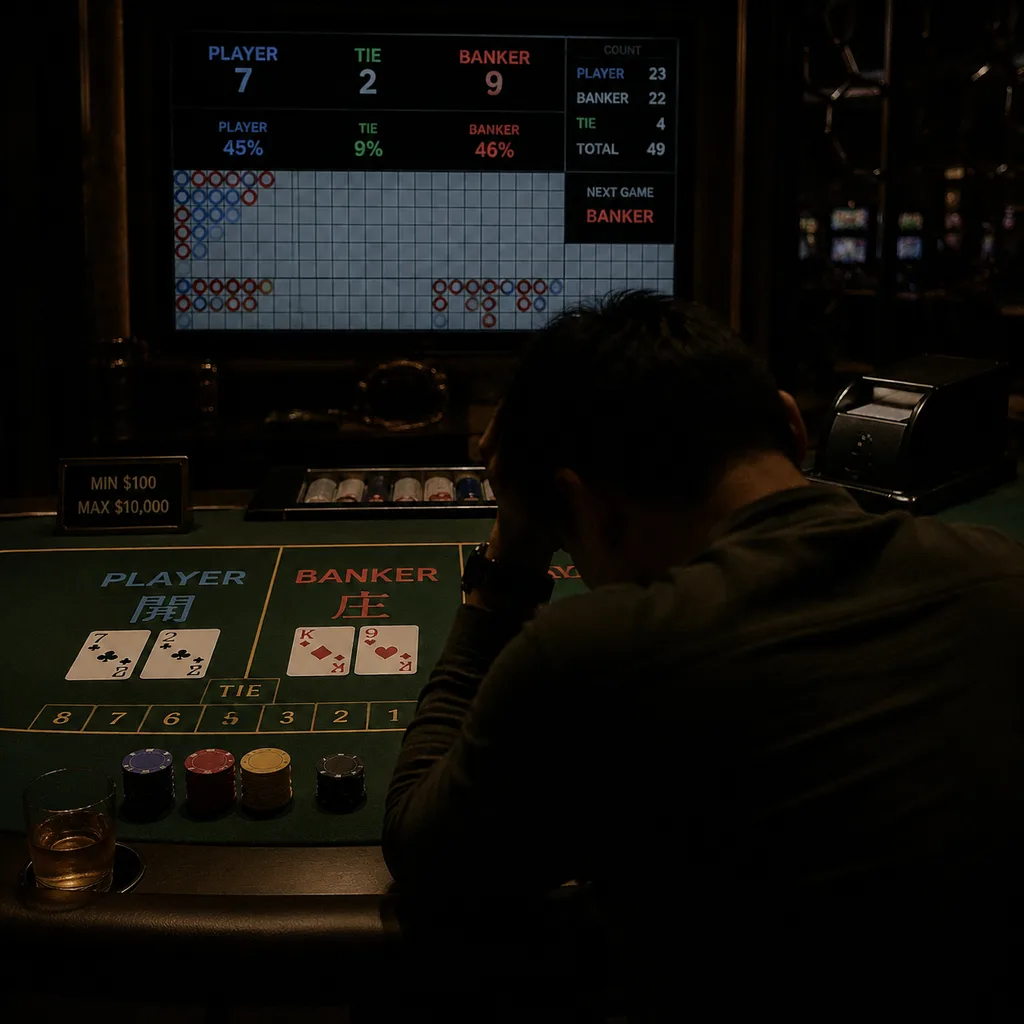
If baccarat has only three main bets, why do players still make worse decisions after an hour? The answer is not that the cards become harder to understand. Baccarat decision fatigue describes what can happen when repeated hands, fast feedback, losses, and scoreboard cues gradually push a player from planned choices into quicker, more emotional reactions.
What is Baccarat decision fatigue?
Decision fatigue generally means a decline in decision efficiency or quality after repeated choices or sustained mental effort. In gambling contexts, it is best treated as a useful behavioral lens, not a settled biological law. Research on choice overload and self-control, including work associated with Kathleen Vohs and colleagues, suggests that repeated choosing can affect later self-control, but broader “ego depletion” claims have also faced replication debate.
For baccarat, the point is practical: fatigue does not prove that a player will lose after a specific number of minutes. It helps explain why a person who began with clear limits may later shorten pauses, ignore their plan, chase losses, or treat a random streak as meaningful.
Why simple baccarat choices become mentally expensive
Baccarat looks cognitively light because the main decisions are usually Banker, Player, or Tie. Yet the table creates many small pressures: repeated outcomes, near-immediate feedback, changing chip stacks, scoreboard history, other players’ reactions, and the temptation to make “just one more” decision. In live and online environments, the pace can reduce natural stopping points, especially when the next hand is available quickly.
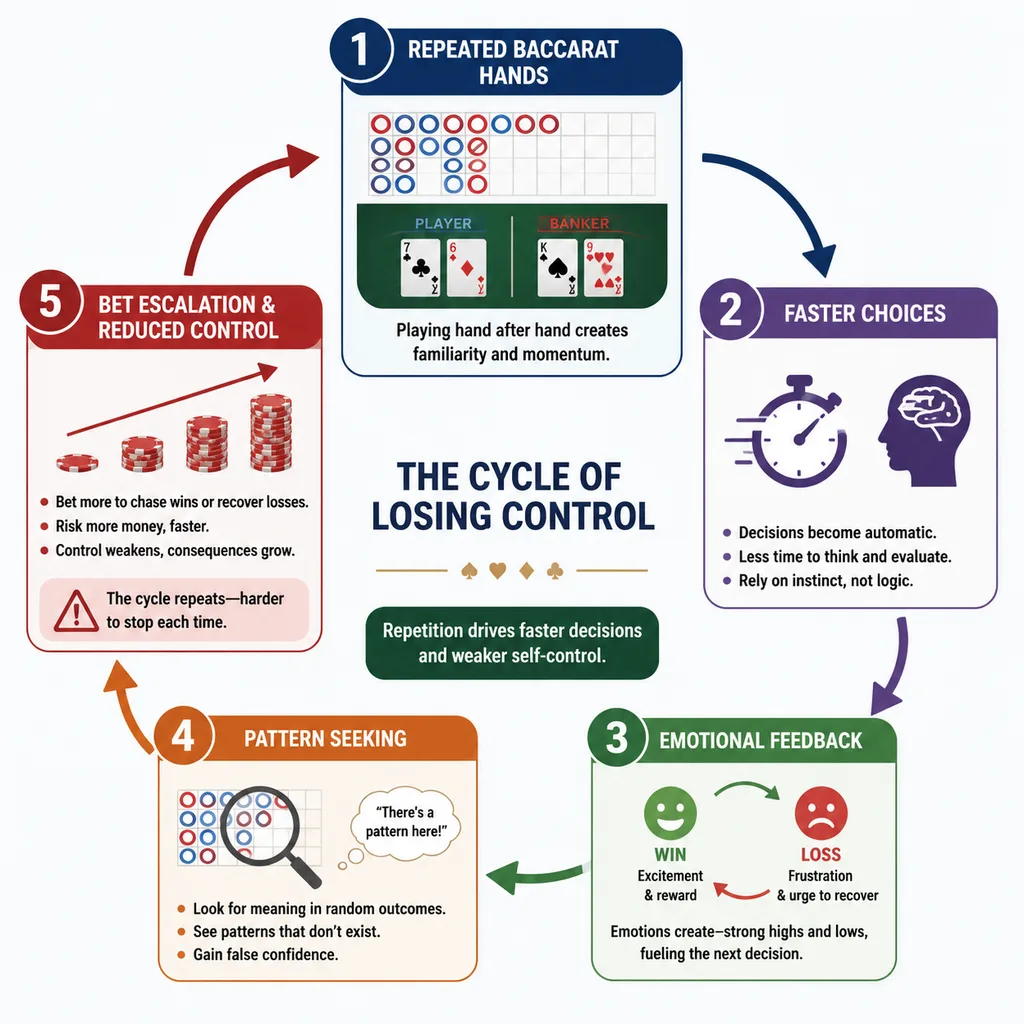
Repetition also turns analysis into autopilot. A player may begin by asking, “Does this bet fit my plan?” Later, the question becomes, “What feels due?” That shift matters. Autopilot is not always reckless in daily life, but at a baccarat table it can make emotional cues feel like evidence.
The math does not change when your brain gets tired
The game’s probabilities do not respond to fatigue, frustration, or confidence. According to the Wizard of Odds house edge table, standard baccarat house edge estimates are about 1.06% for Banker, 1.24% for Player, and 14.36% for Tie. Banker may be the lowest-house-edge basic bet, but it still has negative expectation. A low house edge is not permission to extend a session indefinitely.
The Tie bet is especially relevant to Baccarat decision fatigue. Its high payout can become more attractive when a player feels stuck, bored, or eager to recover quickly. That does not make it predictive. Under fatigue, the mind may overvalue dramatic recovery and undervalue probability. For a deeper mathematical background, see our guide to baccarat house edge.
Baccarat bet type vs fatigue risk
| Bet type | Math reality | Fatigue-driven misconception | Safer behavioral rule |
|---|---|---|---|
| Banker | Lowest common house edge, still negative expectation | “Banker is safe for long sessions” | Use only within pre-set time and loss limits |
| Player | Slightly higher house edge than Banker | “Player must balance the shoe now” | Do not treat recent history as a correction signal |
| Tie | Much higher house edge in standard rules | “A big payout can fix the session” | Avoid using it as an emotional recovery bet |
Behavioral signs that judgment is slipping
Fatigue is easiest to miss because it often feels like confidence. Watch for changes in process, not just results. Warning signs include shorter pauses between hands, increasing stake size without a pre-written reason, irritation after ties or small losses, switching from rules to “gut feeling,” and reading the scoreboard as if it predicts the next result.
- You place bets faster than you did at the start.
- You change your unit size after a loss without a plan.
- You say Banker, Player, or Tie is “due.”
- You keep playing mainly to get even.
- You ignore a session limit you set before starting.
Pattern seeking is a normal human tendency, but random sequences can produce streaks without meaning. If streak interpretation is a recurring issue, read more about the gambler’s fallacy in baccarat.
Decision fatigue, loss chasing, and emotional recovery
Losses can create urgency because they feel like unfinished business. Fatigue makes that urgency easier to justify: a larger bet may feel like discipline, and a Tie bet may feel like an efficient shortcut. In reality, “getting even” is an emotional checkpoint, not a decision checkpoint.
A planned session has limits before the first hand. A reactive session keeps rewriting limits after each emotional result. This is where loss aversion matters: the discomfort of a loss can outweigh the satisfaction of an equal win, pushing the player toward recovery behavior. Our overview of loss aversion explains why this pressure can feel rational in the moment.
What research on breaks suggests
Breaks should not be presented as a way to improve baccarat results. They do not reset odds, predict outcomes, or create an edge. However, research on gambling control suggests that interruptions can affect decision timing. A Current Psychology study on within-session breaks found that enforced breaks increased response latency during sustained losses, with an active response-inhibition intervention appearing stronger than a passive break.
Applied cautiously to baccarat, the lesson is simple: a break may help restore the pause between urge and action. That pause is valuable because fatigue often shows up as speed. An active break is better than staring at the table while waiting; stand up, leave the screen, drink water, or review your pre-set rules away from the hand history.
A practical anti-fatigue framework
Fatigue management is not a betting system. It is a way to protect decision quality and reduce impulsive play.
- Pre-commit the session: decide session length, loss limit, and maximum unit size before playing. For structure, use a written bankroll management plan.
- Use time checkpoints: pause every fixed interval, not only after big wins or losses.
- Track rationale before stake size: if you cannot state why a bet fits your plan, skip the hand.
- Stop on process signals: speed, urgency, anger, boredom, and pattern-seeking are stronger stop signals than the last outcome.
- Separate entertainment from recovery: if the session no longer feels controlled or enjoyable, ending it is the responsible decision.
Common myths about Baccarat decision fatigue
“I can feel when Banker is due.” Feeling due is usually a story built from recent outcomes, not evidence that the next hand has changed.
“Low house edge means long sessions are safer.” Lower house edge reduces mathematical disadvantage compared with worse bets, but longer exposure still means more opportunities for cost and fatigue.
“Fatigue only affects beginners.” Experienced players may know the math better, but they can still become faster, more emotional, or overconfident late in a session.
“A break resets the game.” A break can reset your attention, not the probabilities.
Final takeaway
Baccarat decision fatigue is not about the cards becoming harder to read. It is about the player’s process becoming faster, more emotional, and less rule-based. Fatigue changes the player, not the game. If a session stops feeling controlled or entertaining, taking a break or ending play is a better decision than trying to recover losses.