
Do long banker streaks or tie droughts prove that baccarat is not random? No. Randomness does not require every short session to look balanced, and genuine random sequences can contain clusters, gaps, and striking alternations. A Baccarat Statistical Randomness Test replaces visual impressions with a defined model, a frozen dataset, and tests selected before the results are examined.
A failed statistical test is a signal for investigation, not automatic proof of manipulation.

What Is a Baccarat Statistical Randomness Test?
A randomness test asks whether observed output is compatible with a specified random model. Its null hypothesis might state that outcome frequencies follow the probabilities produced by the documented baccarat rules, or that consecutive outcomes satisfy an independence assumption. The test does not begin with the claim that a system is fair or fraudulent.
The model must reflect the actual variant: deck configuration, drawing rules, card replacement or shoe handling, burn procedures, and the way raw random numbers are converted into cards. Using generic probabilities for a different implementation can manufacture an apparent anomaly.
What Data Should Be Tested?
Outcome frequencies and game details
Banker, player, and tie counts are an accessible starting point, but an audit should retain more detail when available. Final totals, cards drawn per hand, natural outcomes, pair categories, shoe boundaries, timestamps, software versions, and voided rounds help identify where a deviation enters the process. Exclusions must be documented rather than chosen after viewing the results.
Raw output, mapped cards, and displayed results
Raw RNG values, scaled values, shuffled-deck positions, resolved hands, and player-facing outcomes are separate audit layers. A raw stream may pass tests while biased scaling or faulty game logic changes the final distribution. Conversely, a result log alone cannot reveal weak seed generation or duplicated internal streams. Reviews of seed entropy and shuffle integrity therefore complement outcome analysis.
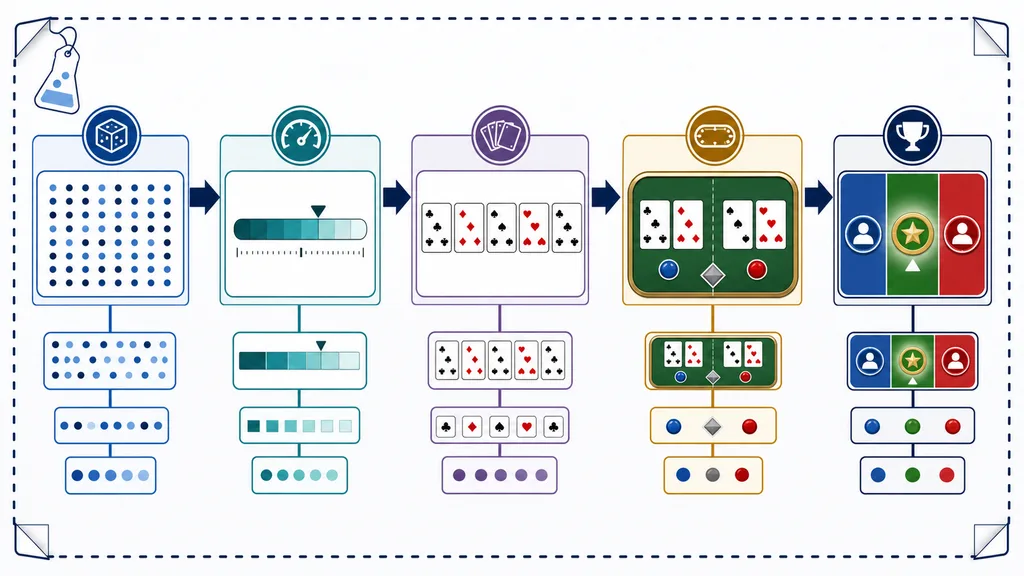
The Main Tests Used in Baccarat Audits
Chi-square goodness-of-fit
This test compares observed and expected counts across predefined categories. It can examine banker, player, and tie frequencies, card-count groups, or final-total bands. Categories need adequate expected counts; sparse groups may require combination or a simulation-based method. The question answered is whether the overall discrepancy is larger than the model would ordinarily produce.
Runs tests
A run is an uninterrupted sequence of the same classified result. Runs tests examine whether there are unusually many or few runs, or unusual clustering, relative to the chosen model. They are useful for investigating streak claims, but a long banker run is not by itself evidence of interference.
Serial correlation and transitions
Serial correlation asks whether values separated by one or more positions move together unexpectedly. Transition analysis compares patterns such as banker-to-player or player-to-player against conditional expectations. These methods can expose dependencies that a frequency table misses, although shoe structure and rule-driven dependence must be represented correctly.
Distribution comparisons
A Kolmogorov–Smirnov test can compare suitable ordered or continuous outputs with a reference distribution. Baccarat outcomes are often discrete, so its standard calibration may not apply directly. Exact, permutation, or simulated reference distributions may be more appropriate. The test should fit the data, not merely appear in a checklist.
How to Interpret P-Values
A p-value is not the probability that manipulation occurred. It measures how unusual the observed statistic would be if the null hypothesis and its assumptions were true. An analysis should define its significance level in advance and report the statistic, p-value, effect size, uncertainty, and sample size together.
Running many tests increases the chance that at least one result appears significant by accident. Auditors should pre-register test families and thresholds, apply an appropriate multiple-testing correction, and distinguish exploratory findings from confirmatory results. Statistical significance also does not establish practical importance.
Why Sample Size Changes the Answer
A short log has limited power: it may contain dramatic-looking streaks while being unable to detect a meaningful bias reliably. A very large dataset can identify a tiny deviation that has little operational consequence. Sample-size planning should specify the smallest relevant effect, desired power, category rarity, dependence structure, and whether observations span independent shoes, servers, seeds, or time periods.
A Practical Randomness Testing Workflow
- Define the system. Record the rules, RNG version, mapping process, platform, and expected mathematical model.
- Freeze the data. Hash or otherwise preserve the extract, establish its time range, and document missing, voided, duplicated, or excluded records.
- Pre-register the analysis. Select frequency and sequence tests, significance levels, corrections, and escalation criteria before inspecting test outcomes.
- Validate the pipeline. Confirm parsing, category labels, ordering, shoe boundaries, and expected-value calculations with controlled examples.
- Run and diagnose. Examine effect sizes and residuals to locate the category, period, or layer responsible for a failure.
- Replicate independently. Test a new period or separately generated stream. Review code, configuration, seed handling, scaling, and operational logs if the anomaly persists.
The UK Gambling Commission’s RTS 7 requirements connect statistical evidence with expected distributions, unpredictability, stream repetition, seeding, scaling, and correct mapping. That broader scope is why a credible audit is more than a chart of hand outcomes.
What a Failed Test Does—and Does Not—Prove
A failure may arise from chance, a wrong reference model, corrupted extraction, unrecorded rule changes, dependence between samples, implementation defects, or deliberate interference. One result cannot identify the cause. Findings are better classified as “within the expected range,” “more data required,” “independent replication required,” or “implementation and operational review required.”
Passing tests is also limited evidence. As NIST SP 800-22 explains, statistical testing is a useful first step but cannot absolutely certify a generator for a particular use or replace cryptanalysis. Passing an outcome test does not establish secure entropy, computational unpredictability, correct deployment, or resistance to attackers.
Audit Checklist
- Document rules, versions, data provenance, time range, and exclusions.
- Separate raw RNG, scaling, shuffle, game logic, and displayed outcomes.
- Calculate expectations from the correct baccarat model.
- Use both frequency and sequence-sensitive tests.
- Report sample size, assumptions, effect sizes, p-values, and corrections.
- Replicate anomalies on independent data and investigate implementation.
- State what the evidence cannot establish.
Frequently Asked Questions
Does a long banker streak indicate a biased RNG?
Not on its own. The relevant evidence is the streak’s frequency under a correctly specified model, evaluated within a preplanned analysis and an adequate sample.
Does passing every selected test prove fairness?
No. It shows that the tested data did not contradict the tested assumptions at the chosen sensitivity. Source code, mapping, seeds, security controls, change management, and live operations remain separate concerns.
Can randomness testing predict the next hand?
No. These tests assess historical compatibility with a model; they are not betting systems and do not remove the house edge.
Statistical testing is one layer of fairness assessment. A defensible baccarat audit states exactly which data, model, implementation, and operating period were examined—and treats unexplained anomalies as questions to replicate and investigate, not instant verdicts.