
Even when game outcomes appear fair, incomplete records make reliable after-the-fact verification impossible. A Baccarat Game History Log Integrity Audit asks whether each hand can be reconstructed from preserved evidence—not whether its outcome looks sufficiently random.
The audit focuses on missing events, duplicates, unauthorized changes, sequence errors, timestamp conflicts, and broken links between gameplay and settlement. It gives operators, auditors, and analysts a repeatable way to assess the evidence without turning every anomaly into an allegation of manipulation.
What Is a Baccarat Game History Log Integrity Audit?
A Baccarat Game History Log Integrity Audit evaluates five properties: completeness, consistency, authenticity, traceability, and availability. A complete log contains the events needed to reproduce a hand. Consistent records agree across systems. Authentic records retain credible evidence of origin and change. Traceable records connect actions to identities and versions. Available records can be retrieved throughout the applicable retention period.
This is different from RNG testing, which examines random-number generation, and from outcome-distribution testing, which searches for statistical anomalies. Settlement verification asks whether balances and payouts were calculated correctly. Log integrity comes first because every later test depends on the reliability of its input data.

Why Game History Logs Need an Integrity Audit
A record may exist yet still be unsuitable for an investigation. A displayed result could omit an interrupted attempt, while a settlement table could contain a payment with no matching hand. Such gaps complicate dispute resolution, incident analysis, internal control testing, and reproducible research.
The central question is practical: can an independent reviewer follow one hand from initiation through cards, outcome, settlement, and final status? If the answer depends on undocumented assumptions or editable screenshots, the evidence is weak even when the visible result is plausible.
What a Complete Baccarat Game Log Should Contain
Each hand should have a unique hand ID linked to a session, table or game instance, account reference where appropriate, rule set, software version, and event sequence. Time fields should include a consistent time standard or explicit time-zone metadata, along with enough precision to order closely spaced events.
The reconstruction set normally includes accepted bets, card values and dealing order, Player and Banker totals, applied drawing decisions, outcome, payout calculation, settlement amount, currency, and final status. Void, cancelled, retried, interrupted, reversed, and incomplete states require explicit flags and reasons rather than silent deletion.
Keep the raw event stream, player-facing history, and financial settlement record logically distinct. They describe different layers and should reconcile through stable identifiers. Database audit logs serve another purpose: they show who changed, deleted, exported, or administered stored data rather than documenting the game itself.
A Practical Integrity Audit Workflow
- Define the population. Record the systems, tables, game versions, jurisdictions, time window, exclusions, retention rules, and extraction method being tested.
- Test structure and sequence. Search for missing IDs, duplicate keys, gaps in event sequences, impossible state transitions, and events recorded after settlement.
- Reconcile independent layers. Join game events to visible results, settlements, account entries, reversals, and dispute records using hand and transaction IDs.
- Compare preserved copies. Match primary data against backups, exports, replicas, or other independently maintained copies where available.
- Review change evidence. Examine clock synchronization, software releases, administrator access, correction jobs, deletions, and reprocessing activity.
Useful measures include the missing-record rate, duplicate rate, orphan settlement count, sequence-inversion count, timestamp-conflict rate, and status-mismatch rate. Row totals alone are insufficient because equal counts can conceal replaced or duplicated hands.
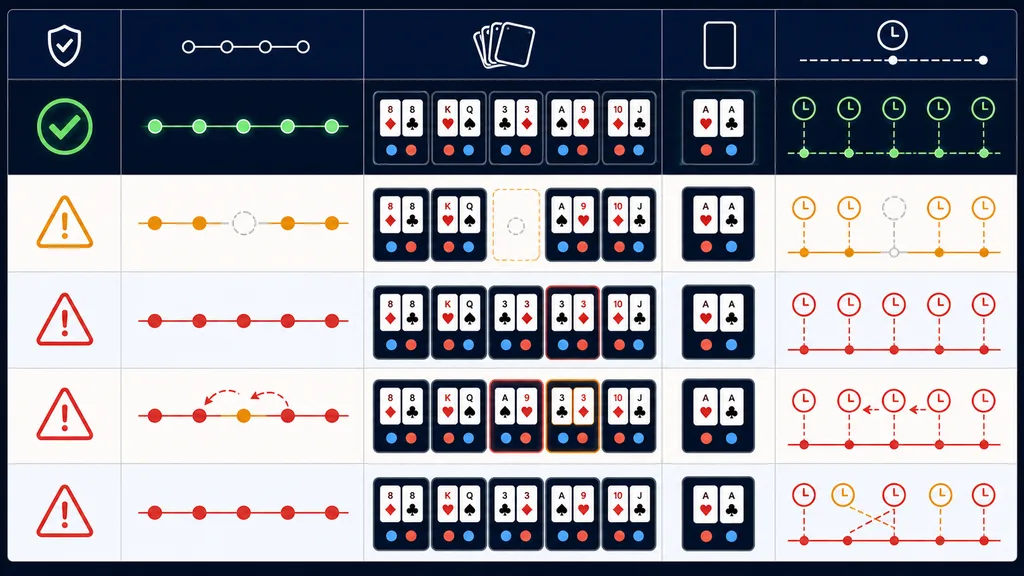
How Missing, Altered, or Duplicated Records Are Detected
Missing-record indicators include unexplained ID gaps, settlements without hands, hands without terminal status, or missing events between bet acceptance and result publication. Duplicate indicators include repeated hand IDs, identical event payloads under new IDs, and multiple settlements for one final state.
Possible post-event modification indicators include hashes that no longer match, updates outside an approved correction workflow, version fields that conflict with deployment history, or administrator activity close to deletion or export events. Hash chains, append-only designs, WORM storage, access logs, and immutable backups can strengthen tamper evidence, but no single technology provides absolute integrity or is universally mandated.
An illustrative example is a hand marked completed at 14:05:12, followed by a card event stamped 14:05:18 and two payout rows. That pattern warrants checking clock behavior, retry logic, and transaction idempotency. It does not by itself prove deliberate alteration.
Statistical Checks Are Useful but Not Sufficient
Outcome frequencies, runs, and distribution tests can identify data that deserves review. They cannot establish that the underlying history is complete or unchanged. Selective retention may bias the sample before any test begins, while a storage defect may create unusual frequencies without affecting the original gameplay.
A p-value is not the probability that manipulation occurred. It measures how compatible a chosen statistic is with a specified model under stated assumptions. Auditors should therefore treat statistics as a supporting layer after population definition, sequence testing, and reconciliation.
What Public Guidance Emphasizes
Requirements vary by jurisdiction, licence, product, and system type. The UK Gambling Commission’s casino equipment requirements discuss audit trails for financial transactions and significant events, regular backups, information sufficient to reconstruct previous play, accurate timestamps, and preservation of relevant historical data during disputes. These are jurisdiction-specific requirements, not universal rules. See the Commission’s electronic device and server-based system requirements.
For a broader security perspective, NIST SP 800-92 presents enterprise guidance for developing and maintaining log-management infrastructure and processes. It is useful as a general framework, not as baccarat-specific regulation.
Baccarat Log Integrity Checklist
- The audit period, population, exclusions, and retention basis are documented.
- Every hand has a unique ID linked to session, table, rules, and software version.
- Timestamps, precision, time zones, and event ordering are consistent.
- Bets, cards, totals, outcomes, payouts, and final states are reproducible.
- Voids, cancellations, interruptions, retries, and reversals remain visible.
- Missing, duplicate, orphaned, and out-of-order records are measured.
- Primary logs are compared with backups or independent records.
- Changes, deletions, privileged access, and remediation retain evidence.
- Exceptions are reproduced, investigated, and assigned a resolution status.
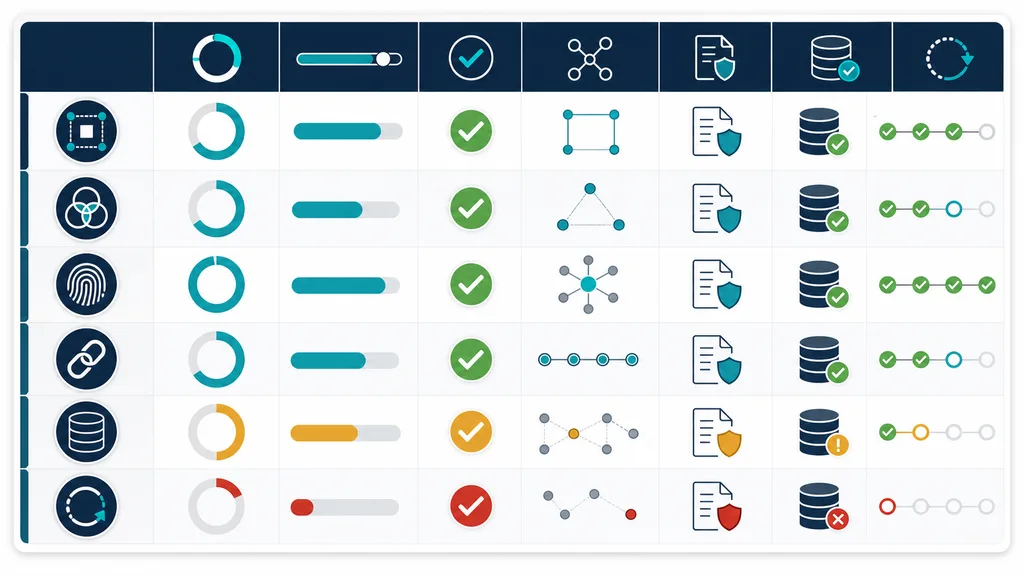
How to Interpret Findings Responsibly
An integrity exception is not automatically proof of manipulated results. A missing hand may arise from an extraction boundary, service interruption, integration failure, clock drift, or faulty retry process. Investigation should first reproduce the issue and compare independent sources.
Repeated patterns confirmed across separate records justify greater scrutiny, especially when they coincide with unexplained access or correction activity. The report should distinguish what was tested from what was not tested and state the sample size, limitations, evidence, likely cause, operational impact, and remediation status.
Frequently Asked Questions
Does a complete history prove baccarat is fair?
No. Completeness supports reconstruction, but fairness requires separate review of game rules, software behavior, randomness where applicable, and settlement logic.
Can duplicate records change an audit result?
Yes. Duplicates can inflate counts, distort distributions, and create false settlement mismatches. Auditors should identify whether duplication occurred during gameplay, storage, export, or reprocessing.
How long should records be retained?
There is no universal period. The applicable regulator, licence conditions, dispute policy, legal obligations, and system risk should determine retention and preservation rules.
Does one missing hand prove manipulation?
No. It proves that the tested record set has an exception requiring explanation. A credible conclusion depends on cause analysis, corroborating evidence, and repeatability.
A Baccarat Game History Log Integrity Audit is not a tool for confirming suspicion or predicting future hands. It is a disciplined process for evaluating whether reproducible evidence exists, where that evidence breaks, and how confidently later reviews can rely on it.