
Baccarat presents only a few main betting choices, yet repeating those choices through a long session can change how they are made. A player who began with a fixed stake may start betting faster, raising amounts after losses, or treating the scoreboard as a prediction. Baccarat decision fatigue does not determine the next result; it describes a possible decline in the consistency and control of the player’s decision process.
What matters most during a long session
- Fatigue can affect attention, patience, and adherence to a plan without changing the cards.
- Banker, Player, and Tie retain their mathematical characteristics regardless of a player’s mental state.
- Faster bets, improvised stake increases, and rewritten limits are observable process warnings.
- Breaks create time between an impulse and an action; they do not improve the probability of winning.

What Is Baccarat Decision Fatigue?
Decision fatigue is best used here as a behavioral framework, not a diagnosis or a fixed biological rule. It refers to the possibility that sustained mental effort makes later choices less consistent, more automatic, or more sensitive to immediate emotion. It should not be assumed that every long-session player experiences the same effect at the same time.
A PLOS ONE experiment on cognitive fatigue and economic decisions compared young university participants who completed 60–90 minutes of demanding cognitive work with a control group. Fatigue did not produce a reliable directional shift in risk preferences; it increased variability across several measures. The experiment was not a baccarat study, so its value is limited to illustrating how consistency may become less stable under cognitive strain.
Why simple choices become mentally expensive
Repetition, fast feedback, and automatic responses
The choice between Banker, Player, and Tie is mechanically simple. The surrounding task is not. A player tracks money, session time, previous outcomes, emotions, and whether current behavior still matches the original plan. Rapid hand resolution leaves little space for that review. Repetition can turn a deliberate selection into a reflexive click or chip placement, especially when attention is divided.
Losses and scoreboard pressure
A run of losses can shift the objective from following a limit to recovering money immediately. At the same time, a scoreboard gives random sequences a vivid visual shape. It records previous results, but it does not establish that Player or Banker is “due.” This error is examined further in our guide to the gambler’s fallacy in baccarat. Scoreboards can organize history; they cannot guarantee the next outcome.
How fatigue can produce betting errors
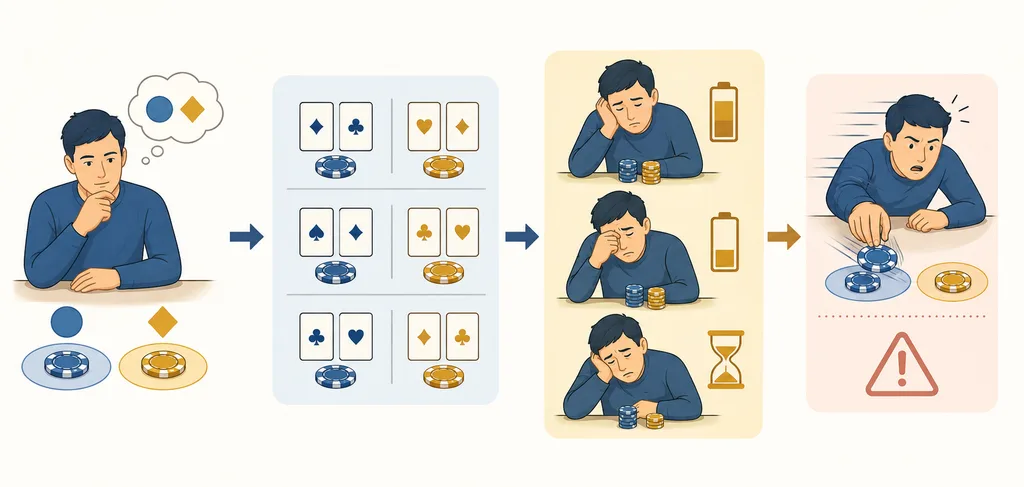
Fatigue does not force one specific bet. It can instead weaken the boundary between an impulse and an action. One player may increase the stake without a pre-set reason; another may abandon a planned Banker or Player choice because a streak looks persuasive. A third may use an emotional Tie bet as an attempted shortcut to recovery despite its substantially higher house edge.
Common process errors include rounding a normal stake upward, placing the next bet before reviewing the last one, adding funds after reaching a loss limit, and redefining “one final hand” several times. These behaviors fit broader baccarat player behavior analysis. They are warning signals rather than proof that a person has a disorder.
Loss chasing deserves particular attention because the goal silently changes. The player is no longer deciding whether a wager fits the plan; the player is trying to erase an uncomfortable result. Fatigue may make that emotional reframing harder to notice, particularly when combined with loss aversion in high-variance decisions.
The mathematics does not become fatigued
| Standard bet | Approximate house edge | What fatigue changes |
|---|---|---|
| Banker | 1.06% | Potentially the player’s stake discipline, not the underlying edge |
| Player | 1.24% | Potentially the reasoning process, not the next-hand probability |
| Tie | 14.36% | Potentially susceptibility to an emotional high-payout choice |
These commonly cited figures assume standard rules and payouts; variants can differ. Our baccarat house edge guide explains the calculations in more detail. Banker’s comparatively low edge does not remove the casino’s long-run advantage, and it is not a winning system. Rest, confidence, experience, and scoreboards cannot alter the fixed rules of a hand.
Signs that betting judgment is slipping
- The interval between results and new bets is becoming noticeably shorter.
- Stake sizes are changing without a reason written before the session.
- Past outcomes are being described as proof that one side must appear next.
- A financial or time limit is being renegotiated only after it has been reached.
- Irritation, urgency, or a need to “get even” is replacing the original plan.
- Basic details such as current loss, elapsed time, or recent stake size are hard to recall.
One sign alone does not diagnose a problem. A cluster of changes, however, is a practical reason to stop rather than test whether discipline will return during the next hand.
Do breaks reduce baccarat betting errors?
A break is useful because it interrupts automatic responding. In a study of 74 adult gamblers using an electronic gaming task under sustained losses, a standard break and an active stop-signal intervention increased response latency. The interventions did not significantly reduce gambling persistence. The Current Psychology study therefore supports a narrow conclusion: an interruption can create more time before the next bet, not a promise that play will stop or outcomes will improve.
An active break means leaving the betting interface, checking elapsed time and money against the original limits, and deciding away from the next-deal countdown. Its purpose is to restore deliberation. It does not make Banker more likely, reset randomness, or improve win rate.
A practical anti-fatigue framework
- Set limits before play. Record a maximum duration, loss amount, and fixed betting unit while no recent result is influencing the decision. Treat them as exit rules, not targets.
- Use time checkpoints. Set alarms at fixed intervals and take a genuine off-screen or away-from-table break. Do not wait until frustration is obvious.
- Write the reason before the stake. If the amount differs from the base unit, record why. “Recover the last loss” and “this side is due” are stop signals, not valid mathematical reasons.
- Stop on process signals. End the session for repeated rushed bets, forgotten totals, limit bargaining, or emotional Tie selections even if the financial ceiling has not been reached.
These controls complement ordinary bankroll management in baccarat, but no budget makes gambling profitable or risk-free. If limits are repeatedly overridden, chasing continues, or gambling is causing financial or emotional harm, the appropriate next step is to stop and use local responsible-gambling or self-exclusion support.
Fatigue changes the player, not the game
Baccarat decision fatigue is useful because it directs attention to observable behavior: speed, stake changes, limit revisions, and reasoning based on “due” outcomes. It should not be used to diagnose every long session or explain every loss. The cards and house edge remain unchanged. The protective goal is simpler—preserve enough distance between feeling an impulse and acting on it, and end the session when that distance is disappearing.