
The game-history window is open beside a copied server-seed hash, while the fairness panel presents a server seed, client seed, nonce, and cursor that look frustratingly similar. This is the moment when a tidy fairness claim becomes a practical audit. The Baccarat Provably Fair Seed Verification Checklist below answers one focused question: do the disclosed seeds and published procedure reproduce the recorded hand? A successful check supports consistency between the saved commitment, revealed inputs, documented algorithm, and displayed round. It cannot inspect a hidden seed, identify production code, certify an operator, alter baccarat’s house edge, or forecast the next hand. I begin each case with a round worksheet, because disciplined evidence keeps the result understandable when the answer remains unresolved.

Build the evidence bundle for one round
Save every value as text where possible and retain screenshots or exported history for context. “Commitment” means the server-seed hash published while the server seed was hidden. “Reveal” means the underlying server seed released after rotation.
| Item | When it should exist | What to preserve |
|---|---|---|
| Server-seed hash | Before play | Full digest, timestamp, and visible session context |
| Client seed | Before play | Exact case-sensitive string |
| Round ID and time | At play | Exported record or complete screenshot |
| Nonce | At play | Exact integer associated with that round |
| Cursor or byte position | At play or calculation | Starting value and increment rule, if used |
| Cards and result | At play | Deal order, suits, ranks, and displayed outcome |
| Revealed server seed | After rotation | Raw text, reveal time, and associated hash |
| Algorithm and mapping | Applicable to round date | Archived page, version, code, or dated documentation |
This minimum bundle keeps timing, identity, calculation, and result evidence together. A hash copied only after reveal can still be calculated, although it supplies weak evidence that the commitment existed when the wager was placed.
Baccarat Provably Fair Seed Verification Checklist before calculation
- Preserve the original commitment. Capture the complete fairness panel with the server-seed hash, timestamp, and round context. A screenshot records presentation, exported history supports sequence, and copied text enables an exact calculation. Keep all three when available.
- Confirm timing. Record how you know the commitment was visible while the underlying seed remained undisclosed. Browser history, a contemporaneous capture, or a signed export carries useful context.
- Copy literal values. Preserve letter case, leading zeros, punctuation, and apparent blank characters. Paste values into a plain-text editor and inspect their lengths. I have traced a failed comparison to one invisible trailing space.
- Bind the nonce to the round. A nonce commonly increments across wagers under one seed pair. Starting values, resets, cancelled bets, and skipped rounds depend on the published implementation. Use the round record instead of guessing from nearby entries.
- Identify the historical version. Save the generator, conversion, card array, and baccarat rule documentation applicable on the round date. A current help page may describe revised behavior.
- Label illustrative data. If you test with invented seeds, mark them “fictional” so they never become mixed with the evidence file.
Name the evidence folder with the round ID, save originals as read-only copies, and place working copies in a separate subfolder. This simple chain-of-custody habit prevents an innocent edit from becoming an apparent discrepancy.
Check the server-seed commitment
Find the operator’s specified commitment function, commonly SHA-256, then compute it over the revealed server seed exactly as received. SHA-256 is a hash function that produces a message digest. It is not encryption, and the digest is not normally “decrypted.” Compare the complete computed digest character by character with the pre-bet server seed hash.
- Record the stated hash algorithm and expected digest format.
- Confirm the seed’s character encoding, commonly UTF-8 when documentation specifies it.
- Remove no characters unless the specification explicitly directs it. Test suspected newline or whitespace issues on a copy.
- Compare complete values, including leading zeros, and record the tool and tool version.
- Mark pass for an exact match, fail for a confirmed mismatch, or unresolved when timing, encoding, or algorithm evidence is missing.
This test covers commitment continuity. Outcome generation may use HMAC-SHA-256, a keyed construction combining a key and message through a cryptographic hash function. Key selection, message order, separators, encoding, and case all affect the output. A plain SHA-256 commitment check and an HMAC outcome calculation therefore belong on separate worksheet lines.
Reconstruct the recorded baccarat hand
Follow the provider’s round-date specification as a literal recipe. Enter the revealed server seed, client seed and nonce, plus the documented cursor or block counter. In an HMAC design, confirm which value serves as the key and the exact message string. Generate the digest, preserve its raw bytes, and extend to later blocks only through the stated cursor rule. Then reproduce byte grouping, byte-to-float conversion, rejection steps, rounding, and array indexing. A nonce identifies successive wagers under a seed pair; a cursor selects additional bytes or blocks within the generation process. They are never safe substitutes.
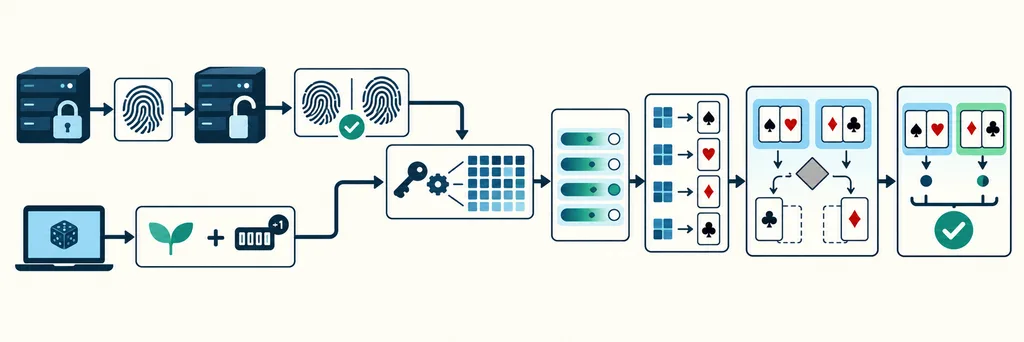
Next, apply the documented game mapping. Confirm card-array order, whether selection uses replacement, and the number of generated card events. As an operator-specific example, Stake’s published implementation uses the server seed as an HMAC-SHA-256 key and builds its message from the client seed, nonce, and current round. Its separate baccarat event documentation maps floats into a 52-entry card array under an unlimited-deck model and generates up to six card events. That recipe cannot be generalized to a finite multi-deck shoe, live-dealer game, or another proprietary product. Those products require their applicable documentation and may raise separate questions concerning digital baccarat shuffle integrity.
Finally, deal the cards in the specified sequence, usually Player first card, Banker first, Player second, and Banker second, followed by any required third cards. Convert ranks to baccarat point values, calculate totals modulo 10, apply the documented natural and third-card rules, and compare Player, Banker, or Tie with the displayed outcome.
| Check | Expected evidence | Reproduced value | Recorded value | Status |
|---|---|---|---|---|
| Commitment digest | Saved pre-bet hash | Full computed hash | Full saved hash | Pass/Fail/Unresolved |
| Generator output | Versioned formula | Bytes or floats | Verifier output, if available | Pass/Fail/Unresolved |
| Card mapping | Array and selection rule | Ordered cards | History cards | Pass/Fail/Unresolved |
| Baccarat rules | Variant rules | Totals and draw decisions | Shown hand | Pass/Fail/Unresolved |
| Final outcome | Settlement rule | Player/Banker/Tie | Displayed result | Pass/Fail/Unresolved |
An official provably fair baccarat verifier is a useful comparison point. Independent calculation with inspectable code provides stronger reproducibility. I have seen two tools agree on a digest while both were configured with the wrong card mapping, so agreement at one layer never closes the later worksheet rows.
Locate a mismatch without losing the evidence
| Layer | Likely cause | Next check |
|---|---|---|
| Round identity | Wrong seed pair, rotation boundary, missing or duplicated round | Align round IDs, timestamps, and seed activation times |
| Inputs | Nonce off by one, case change, hidden whitespace | Compare raw lengths and exported values |
| Generator | Wrong HMAC key/message order, delimiter, encoding, or cursor | Log the exact message and intermediate bytes |
| Version | Outdated documentation or changed algorithm | Request dated code or an archived specification |
| Mapping | Different array, replacement rule, rounding, or baccarat variant | Reproduce each card index and draw decision |
| Unexplained | Evidence complete and divergence remains | Freeze records and request technical review |
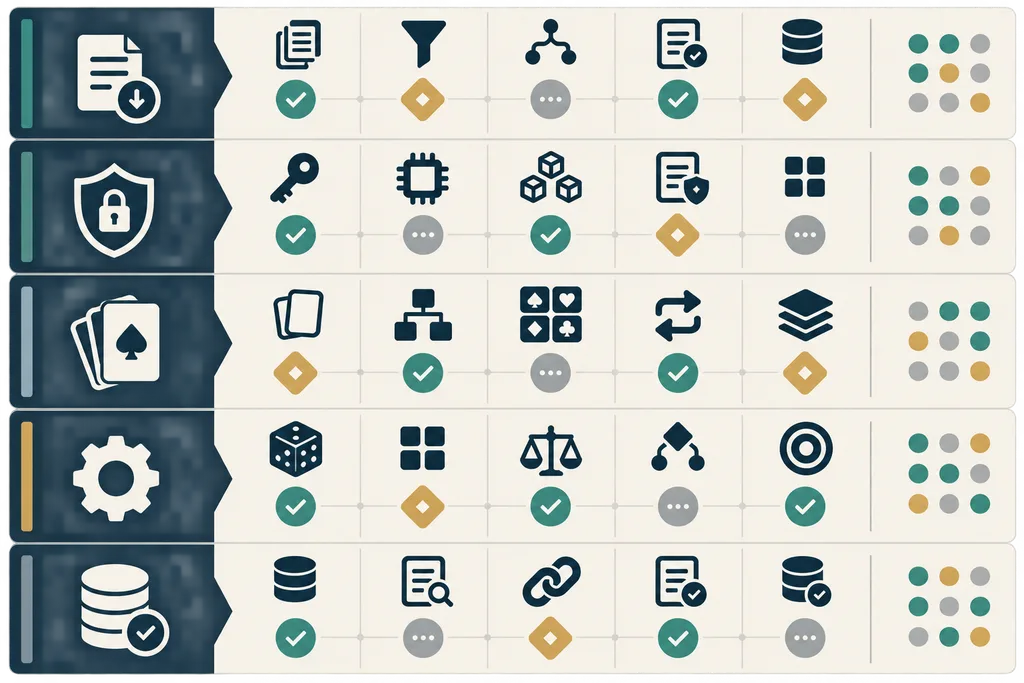
A seed-rotation boundary once explained a nonce that appeared one step wrong in a community record: the calculation was sound, while the round belonged to the next pair. Diagnose from the earliest failed layer and preserve each intermediate value. If divergence survives, describe it neutrally: “Using specification version X and the attached inputs, byte block Y differs at position Z.” Ask for the historical specification, raw round record, seed-activation time, and treatment of cancelled rounds. “Unresolved discrepancy” remains the accurate status until stronger records support a firmer finding.
Understand what a passed round establishes
A complete match supports consistency for that round under the disclosed seed set and identified algorithm. It leaves several audit questions open: the entropy and unpredictability of the original server seed, whether documented code matched production, whether historical documentation is complete, whether records were selectively disclosed, and whether logs were altered. Settlement accuracy, licensing, solvency, and platform certification also require their own evidence. Further review of seed entropy and RNG integrity belongs in that wider assessment.
Likewise, baccarat statistical randomness testing evaluates patterns across a dataset; it cannot reconstruct a specific hand. One verified hand cannot characterize a long sequence. Seed verification also supplies no predictive advantage while the committed server seed remains properly hidden, and it does not change probabilities or the house edge.
Score your Baccarat Provably Fair Seed Verification Checklist
Give one point for each completed statement:
- I preserved the server-seed hash with evidence that it existed before play.
- I have the exact revealed server seed, client seed, nonce, and required cursor data.
- The revealed server seed reproduces the saved commitment hash.
- An independent calculation using the applicable version reproduces the ordered cards.
- The displayed result follows the documented baccarat dealing and scoring rules.
- Reproducible, 5 points: Retain the worksheet, source records, intermediate values, code or verifier version, and calculation date.
- Incomplete, 0–4 points with missing evidence: List each absent field and request it. Do not convert absence into a failed result.
- Discrepant, 0–4 points with complete evidence and confirmed divergence: Identify the first failed layer, repeat the check with an inspectable method, and preserve a neutral escalation package.
A hash failure makes later reconstruction unreliable for that claimed seed pair. A hash pass followed by a card mismatch directs attention to generator inputs, versions, conversion, mapping, or game rules.
Frequently asked questions
Does a matching hash prove complete fairness?
No. It shows that the revealed seed matches the saved commitment under the stated hash calculation. Seed quality, deployed code, complete logging, settlement, and broader operator conduct remain separate matters.
Can I verify the server seed before it is revealed?
You can preserve its commitment hash. Reproducing that hash requires the underlying seed, which normally becomes available after rotation. The delayed reveal protects upcoming outcomes from straightforward calculation.
Why might my nonce be off by one?
Possible causes include a different starting convention, a seed reset, a cancelled wager, a missing history entry, or an incorrectly associated round. Check the operator-specific rules and timestamps.
Is an online verifier sufficient?
It provides useful corroboration when its inputs, version, and intermediate outputs are visible. Preserve the original records and, where practical, repeat the published procedure locally or with independently inspectable code.
Can verification predict future baccarat hands?
No. A properly hidden server seed prevents advance reconstruction. Post-reveal verification is retrospective and offers no betting advantage.
A reproducible claim has a clear boundary
When I review a fairness dispute, the most useful worksheet is rarely the one with the strongest accusation. It is the one another person can rerun, line by line, while seeing exactly where the evidence ends. Preserve the commitment, identify the historical recipe, expose every intermediate value, and name uncertainty honestly. A narrow conclusion that survives reproduction contributes more to baccarat accountability than a sweeping claim built on an incomplete record, and it leaves the next reviewer with a precise question worth answering.