
Two calculator tabs sit open on the same screen. One reports a 45.86% Banker win probability; the other shows 50.68%. Their Player figures differ too, and the house-edge boxes seem close enough to be related while still refusing to match. When this happens, the useful question is not which tab looks more convincing. It is which rules, denominators, payouts, and numerical methods produced each result.
This guide explains How to troubleshoot baccarat odds calculator discrepancies with a repeatable audit. You will identify the disputed value, normalize the model, rebuild the expected return, and classify the residual difference. A mismatch alone says nothing about dealing integrity or casino conduct; calculator comparison examines a mathematical model, while a full baccarat RNG output audit requires separate evidence.

Start by naming the number that disagrees
Labels such as “odds” and “return” often hide different quantities. Before checking arithmetic, write the full meaning of every displayed number:
- Outcome probability is the chance that Banker, Player, or Tie occurs across all dealt hands.
- Conditional win probability removes ties and asks for one side’s share of resolved Banker-or-Player outcomes.
- Payout odds describe the settlement contract. They do not describe how frequently an outcome occurs.
- Expected value (EV) is the average net profit or loss per unit staked, after every win, loss, push, and commission is weighted by probability.
- House edge is the negative of player EV when both use the same normalized stake convention.
- Return to player (RTP) is commonly written as
1 − house edgefor a normalized wager, though a tool may label gross return, resolved-hand return, or another convention as RTP.
The quantitative eight-deck reference published by Wizard of Odds gives Banker 0.458597, Player 0.446247, and Tie 0.095156 across 4,998,398,275,503,360 combinations. These round to 45.8597%, 44.6247%, and 9.5156%. Removing ties changes the question: 0.458597 ÷ (0.458597 + 0.446247) ≈ 50.68%. Both Banker percentages can therefore be consistent with the same outcome model.
Freeze the rules and inputs before comparing outputs
I begin an audit by recording every visible selection and every undocumented default. Deck count matters: the same reference reports six-deck probabilities of about 0.458653 Banker, 0.446279 Player, and 0.095069 Tie. A fresh shoe also differs from a current shoe with known removed cards. Standard shoe calculations deal without replacement, so remaining card composition changes subsequent probabilities.
Confirm point values and drawing logic as well. Aces count as one, tens and face cards count as zero, and hand totals use the rightmost digit. The third-card rules determine when Player and Banker draw. Then inspect the contract: Banker commission, Tie payout, side-bet pay table, and special pushes. The Massachusetts baccarat rules, for example, describe six-to-eight-deck play, standard 5% vigorish, equal-count pushes, and EZ Baccarat treatment in which a Banker Dragon 7 pushes. A standard commission result cannot be carried into that variant unchanged.
| Assumption | Calculator A | Calculator B | Normalized test |
|---|---|---|---|
| Deck or shoe state | Fresh 8 decks | Record value | Use the same remaining card counts |
| Dealing model | Without replacement | Record value | Apply standard drawing rules |
| Banker settlement | 5% commission | Record value | Net win equals +0.95 |
| Tie settlement | Push on main bets | Record value | Net result equals zero |
| Tie wager | 8 to 1 | Record value | Net win equals +8 |
| Variant and side bets | Standard punto banco | Record value | Disable extras |

Check the denominator and settlement language
The 45.86% versus 50.68% example is the classic denominator clue. The first number includes ties among all hands. The second conditions on a resolved Banker-or-Player result. For main-wager EV, a tie remains in the full probability space and contributes zero because the stake is returned. Deleting it and treating the conditional rate as an unconditional win chance inflates the calculation.
Payout wording creates another trap. “8 to 1” on Tie means eight units of net profit plus the original stake. “9 for 1” can describe the same total amount returned. Entering 9 as net profit adds one unit incorrectly. With an 8-to-1 Tie payout, the calculation is EV = 8 × P(Tie) − [1 − P(Tie)], giving about −0.143596, or a 14.3596% house edge, at the eight-deck benchmark.
Commission changes value without changing the physical chance that Banker wins. For a standard 5% commission bet, EV = 0.95 × P(Banker) − P(Player). Substitution gives approximately −0.010579, so the house edge is about 1.0579%. Player uses EV = P(Player) − P(Banker), producing about −0.012351 and a 1.2351% edge. If a tool reports 1.06% and another reports 1.17%, inspect commission, push handling, stake normalization, and variant rules before touching the probability engine.
Separate exact results from simulated estimates
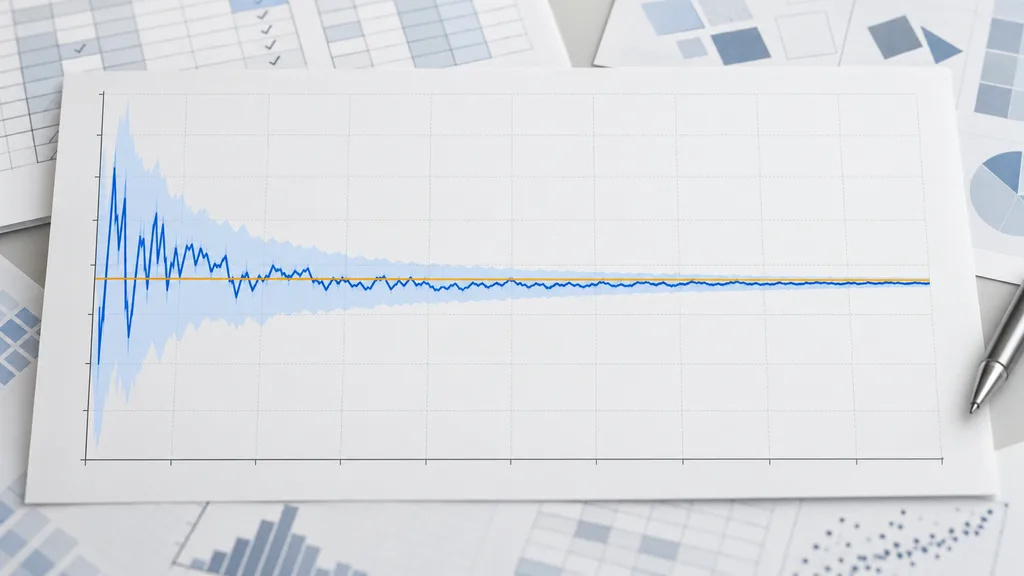
An exact enumerator should return the same result every time when its rules and shoe composition are identical. A Monte Carlo calculator samples random hands, so its last digits move with the seed, trial count, and sampling implementation. A useful simulation result should disclose the number of trials and some measure of uncertainty. As trials increase, estimates generally move closer to the exact benchmark, although no single run is promised to land exactly on it.
When I compare a simulator with an exact table, I first run enough trials to see whether the gap behaves like sampling noise. If results shift after every click and the shifts shrink at larger sample sizes, the symptom fits variance. Persistent displacement in one direction suggests a model or code issue worth isolating. Testing observed game logs is a related, separate exercise covered in a baccarat statistical randomness test.
Also inspect the numerical plumbing. A decimal probability such as 0.1 usually has no exact binary floating-point representation. Intermediate rounding can accumulate; converting 0.458597 to 45.8597 and then multiplying it as though it were still a decimal creates a factor-of-100 error. Export the highest available precision, compare with a stated tolerance, and round only the final display. Totals such as 99.99% or 100.01% can be harmless when three individually rounded categories are added. A large gap, a failed checksum at full precision, or a misplaced percent sign needs deeper investigation.
How to troubleshoot baccarat odds calculator discrepancies step by step
- Capture the evidence. Save both tools’ inputs, version or access date, outputs, precision, and any help text. Record the exact field that conflicts.
- Normalize terms and units. Translate percentages to decimals and label each figure as overall probability, conditional probability, net payout, total return, EV, house edge, or RTP.
- Freeze one ruleset. Specify deck count, remaining shoe, replacement assumption, drawing table, commission, push rules, Tie payout, variant, and side-bet pay table.
- Run the checksum. Mutually exclusive Banker, Player, and Tie probabilities must sum to one within your chosen tolerance.
- Test a known benchmark. For a fresh standard eight-deck shoe, compare the full-precision output with the published 0.458597, 0.446247, and 0.095156 values. Use six-deck values only for a six-deck model.
- Rebuild EV. Put the outcome probabilities and net settlements in a small spreadsheet. Multiply each result by its probability, then sum the products. I often use a short script as a second check.
- Control simulation noise. Record the seed when possible, increase trials, repeat runs, and compare the estimate with an exact combinatorial reference.
- Compare unrounded values. Set an absolute tolerance appropriate to the published precision. Keep display formatting outside the core calculation.
- Change one assumption at a time. Toggle deck count, commission, denominator, or variant individually. The output movement identifies which assumption explains the gap.
- Document the residual. Preserve a minimal reproducible case with inputs, expected output, actual output, formulas, and tolerance. Describe it as an unresolved discrepancy until implementation evidence supports a stronger conclusion.
Match the symptom to the next check
| Observed symptom | Likely cause | Verification step | Expected resolution |
|---|---|---|---|
| 45.86% versus 50.68% Banker | All hands versus resolved hands | Divide Banker by Banker plus Player | Labels and denominators reconcile |
| 1.06% versus 1.17% Banker edge | Commission, push, or variant mismatch | Rebuild EV from net settlements | Edge matches the frozen contract |
| Result changes on every run | Monte Carlo variance | Record trials and repeat with a larger sample | Spread narrows around the benchmark |
| Difference appears only in Tie edge | 8-to-1 versus 9-for-1 interpretation | Separate net profit from returned stake | EV uses +8 on a Tie win |
| Rounded categories total 99.99% or 100.01% | Display precision | Sum unrounded values | Total falls within tolerance of one |
| Large gap only in no-commission play | Special push or pay-table rule | Check Dragon 7 and every exception | Variant-specific model explains the gap |
A reproducible defect becomes credible when identical documented inputs produce a stable output that violates the checksum, a transparent EV formula, or a trusted exact benchmark beyond the defined tolerance. Screenshots help, and a compact input file or calculation sheet helps more. Neutral documentation gives a developer enough information to reproduce the issue without turning an arithmetic investigation into an unsupported fairness allegation.
Frequently asked questions
Which baccarat odds calculator should I trust?
Trust a result provisionally when the tool discloses its rules, denominator, payouts, method, and precision, and when you can reproduce a benchmark. A polished interface provides little evidence by itself.
Does deck count make a meaningful difference?
Yes, the probabilities change slightly. The difference can matter in a precision audit, especially when one calculator assumes six decks and another assumes eight. Current-shoe composition may create a larger change.
Should a simulation exactly match an exact result?
No. It should fluctuate within a plausible sampling range and generally converge as trials grow. Report the trial count, seed when available, and uncertainty alongside the estimate.
Does a discrepancy show that a game is rigged?
No. It first shows that two reported values differ. Evidence about live implementation, RNG behavior, data integrity, and operations would be needed for a game-level conclusion.
How much rounding difference is acceptable?
Base the tolerance on displayed precision. Two values rounded to four decimal places may differ in hidden digits while displaying the same result. Compare full precision, state an absolute tolerance, and investigate any gap that survives consistent rounding.
Return to the two tabs with a documented model
The two calculator tabs now look less mysterious. One may describe all hands, another resolved hands; one may use exact enumeration, another a finite simulation; one may apply standard commission, another a special push. Once the model, denominator, settlement contract, and precision are written down, most differences become explainable and the remaining ones become testable.
That is the lasting lesson in How to troubleshoot baccarat odds calculator discrepancies: every percentage is an answer to a precisely framed question. Before deciding what a number means, ask which question the calculator actually solved.